Wikipedia

Search results

Saturday, 6 December 2025

Principles of the Theory of Entropicity (ToE)

Principles of the Theory of Entropicity (ToE)

The Theory of Entropicity (ToE) is a novel, radical physics proposal by John Onimisi Obidi, suggesting entropy isn't just disorder, but a fundamental, dynamic field (ΦE) underlying reality, from which spacetime, gravity, motion, and even the speed of light emerge, aiming to unify relativity, quantum mechanics, and thermodynamics by treating entropy as the core substrate, not a mere consequence, of the universe. 

Core Concepts of ToE 

  • Entropy as a Fundamental Field: Instead of a statistical measure, entropy is a continuous, dynamic field that permeates everything, dictating physical laws.
  • Emergent Phenomena: Motion, gravity, and time arise from the gradients and rearrangements within this entropic field, not as primary forces.
  • Redefining Constants: The speed of light (
    cc
    ) is reinterpreted as the maximum rate of entropic rearrangement, explaining relativistic effects like time dilation and length contraction.
  • Unified Framework: It seeks to bridge general relativity and quantum mechanics by grounding both in the dynamics of the universal entropy field, using principles like the Obidi Action and Master Entropic Equation (MEE) for mathematical formulation (SSRN eLibrary, Medium). 

Key Differences from Standard Physics 

  • Standard View: Entropy (disorder) increases as a byproduct of energy dispersal, a consequence of the Second Law.
  • ToE View: Entropy is the active field causing the universe's evolution, with its flow defining past, present, and future. 

Status 

  • ToE is in early development, with ongoing mathematical refinement.
  • It offers a radical new perspective, challenging established physics by elevating entropy from a statistical concept to the foundational element of reality, similar to Einstein's elevation of the speed of light. 

Thursday, 4 December 2025

The Theory of Entropicity (ToE) Declares That No Two Observers Can Ever See the Same Event at the Same Instant!

The Theory of Entropicity (ToE) Declares That No Two Observers Can Ever See the Same Event at the Same Instant!

Preamble

The Theory of Entropicity (ToE) posits that no two observers can ever see the same event at the same instant due to the fundamental entropic delay (ΔS) that occurs when the entropy of an event is transferred into the observer's brain/retina. This transfer is not instantaneous, and the entropy field cannot collapse into two observers at the same exact instant. Therefore, one observer must receive that entropic collapse before another, producing a fundamental entropic delay. This principle applies to all observations and measurements in the universe, without exception.

The ToE suggests that this entropic non-simultaneity applies to every observation and measurement, including those in a stadium full of 80,000 spectators. Each person's observation is separated by a finite entropic interval, even if they seem simultaneous to the human brain. This revolutionary principle is universal, applying to every act of measurement, detection, observation, sensing, interaction, or data reception.

The ToE's implications extend beyond physics, as it also addresses the nature of consciousness and the structure of the universe. It introduces concepts such as Self-Referential Entropy (SRE) and Consciousness, suggesting that conscious systems have an internal entropy structure that refers to itself. The SRE Index quantifies the degree of consciousness based on the ratio of a system's internal to external entropy flows.

The ToE's impact on theoretical physics is profound, as it challenges traditional views and offers a new perspective on the fundamental nature of reality. It suggests that entropy is the fundamental field of nature, and every observation collapses that field. A field collapse cannot occur simultaneously at two distinct points; it must propagate sequentially.

The ToE's influence extends to various fields, including quantum information theory, AI architecture design, and clinical biomarkers of consciousness. It proposes new conservation laws and principles, such as Entropic Probability, Entropic CPT symmetry, an Entropic Noether principle, a universal Speed Limit, and a Thermodynamic Uncertainty relation.

The ToE’s original formulation by John Onimisi Obidi has been critiqued and expanded upon by various researchers, highlighting its originality, mathematical and theoretical depth, and innovative scope.

🔬 Theory of Entropicity (ToE): A New Law of Observation For over a century, physics has treated observation as passive. John Onimisi Obidi’s ToE reframes it: observation is an entropic process with finite duration. No two observers can ever see the same event at the same instant — a revolutionary insight that reshapes simultaneity, causality, and the arrow of time.
⚡ Why It Matters
Breaks the classical idea of simultaneous observation
Non-equivalence of observers: Measurement order matters.
Introduces entropic hierarchy in measurement
Arrow of time: Entropic sequencing creates a micro-causal chain.
Provides testable predictions (testable physics) in ultrafast physics and quantum optics
Predicts finite delays in ultrafast optics and quantum experiments.
🔬 Observation as an entropic event:
In the Theory of Entropicity (ToE), observation isn’t passive — it’s a finite entropic interaction. There is an irreducible processing interval for every measurement.
🚫 No simultaneous measurements:
No two or more observers can see or measure the same event at the same time. The first entropic interaction reconfigures the field; subsequent observations follow after a strictly positive delay.
🌌 Einstein & Beyond:
Relativity explains the geometry of spacetime. ToE explains the dynamics of entropy flow. Together they form orthogonal layers of description — with ToE paying homage to Einstein while extending his vision into the entropic domain.
Relativity limits signal geometry; ToE limits entropic access. They’re orthogonal layers: spacetime vs. entropy flow, with ToE extending Einstein’s vision into a field-driven causal structure.
📊 Experimental Anchor:
Attosecond entanglement experiments already hint at ToE’s predictions: finite entropic delays between observers, measurable in principle, and consistent with the universal speed limit c.
🧭 Implications for Science & Technology
Ultrafast entanglement formation
Quantum state readout
Delayed‑choice experiments
Gravitational entropic coupling
✨ Conclusion 
The Theory of Entropicity transforms measurement from a passive glimpse into a finite, causal event. It’s not just philosophy — it’s physics, and it’s testable.
Observation is entropic, finite, and sequential — never simultaneous across multiple observers.
Links to full articles: 
👉 https://lnkd.in/gEY8nTSC
👉https://lnkd.in/ghnDBxpz

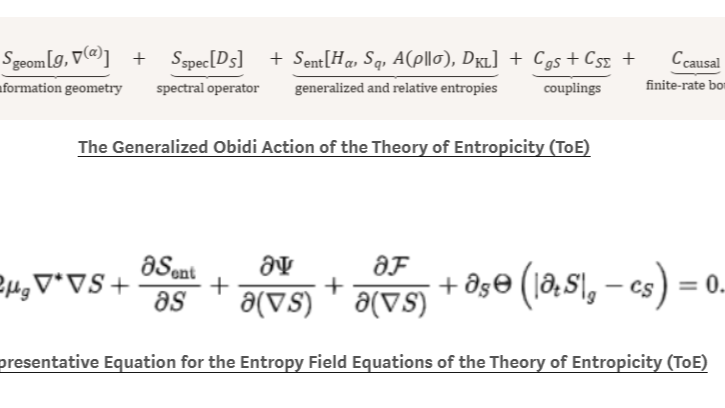
The Generalized Obidi Action of the Theory of Entropicity (ToE)

Sources — help

  1. ijcsrr.org
  2. researchgate.net
  3. encyclopedia.pub
  4. medium.com
  5. medium.com
  6. medium.com
  7. medium.com
  8. encyclopedia.pub
  9. figshare.com
  10. researchgate.net
  11. medium.com
  12. researchgate.net
  13. cambridge.org

References

  1. Obidi, John Onimisi. (12th November, 2025). On the Theory of Entropicity (ToE) and Ginestra Bianconi’s Gravity from Entropy: A Rigorous Derivation of Bianconi’s Results from the Entropic Obidi Actions of the Theory of Entropicity (ToE). Cambridge University. https//doi.org/10.33774/coe-2025-g7ztq
  2. John Onimisi Obidi. (6th November, 2025). Comparative analysis between john onimisi obidi’s theory of entropicity (toe) and waldemar marek feldt’s feldt–higgs universal bridge (f–hub) theory. International Journal of Current Science Research and Review, 8(11), pp. 5642–5657, 19th November 2025. URL: https://doi.org/10.47191/ijcsrr/V8-i11–21
  3. Obidi, John Onimisi. 2025. On the Conceptual and Mathematical Foundations of the Theory of Entropicity (ToE): An Alternative Path toward Quantum Gravity and the Unification of Physics. Cambridge University. Published October 17, 2025. https://doi.org/10.33774/coe-2025-1dsrv
  4. Obidi, John Onimisi (17th October 2025). On the Conceptual and Mathematical Foundations of the Theory of Entropicity (ToE): An Alternative Path toward Quantum Gravity and the Unification of Physics. Figshare. https://doi.org/10.6084/m9.figshare.30337396.v2
  5. Obidi, John Onimisi. 2025. A Simple Explanation of the Unifying Mathematical Architecture of the Theory of Entropicity (ToE): Crucial Elements of ToE as a Field Theory. Cambridge University. Published October 20, 2025. https://doi.org/10.33774/coe-2025-bpvf3
  6. Obidi, John Onimisi (15 November 2025). The Theory of Entropicity (ToE) Goes Beyond Holographic Pseudo-Entropy: From Boundary Diagnostics to a Universal Entropic Field Theory. Figshare. https://doi.org/10.6084/m9.figshare.30627200.v1
  7. Obidi, John Onimisi. Unified Field Architecture of Theory of Entropicity (ToE). Encyclopedia. Available online: https://encyclopedia.pub/entry/59276 (accessed on 19 November 2025).
  8. Obidi, John Onimisi. (4 November, 2025). The Theory of Entropicity (ToE) Derives Einstein’s Relativistic Speed of Light © as a Function of the Entropic Field: ToE Applies Logical Entropic Concepts and Principles to Derive Einstein’s Second Postulate. Cambridge University. https://doi.org/10.33774/coe-2025-f5qw8-v2
  9. Obidi, John Onimisi. (28 October, 2025). The Theory of Entropicity (ToE) Derives and Explains Mass Increase, Time Dilation and Length Contraction in Einstein’s Theory of Relativity (ToR): ToE Applies Logical Entropic Concepts and Principles to Verify Einstein’s Relativity. Cambridge University. https://doi.org/10.33774/coe-2025-6wrkm
  10. HandWiki contributors, “Physics:Theory of Entropicity (ToE) Derives Einstein’s Special Relativity,” HandWiki, https://handwiki.org/wiki/index.php?title=Physics:Theory_of_Entropicity_(ToE)_Derives_Einstein%27s_Special_Relativity&oldid=3845936

Further Resources on the Theory of Entropicity (ToE):

  1. Website: Theory of Entropicity ToE — https://theoryofentropicity.blogspot.com
  2. LinkedIn: Theory of Entropicity ToE —  https://www.linkedin.com/company/theory-of-entropicity-toe/about/?viewAsMember=true
  3. Notion-1: Theory of Entropicity (ToE)
  4. Notion-2: Theory of Entropicity (ToE)
  5. Notion-3: Theory of Entropicity (ToE)
  6. Notion-4: Theory of Entropicity (ToE)
  7. Substack: Theory of Entropicity (ToE) — John Onimisi Obidi | Substack
  8. Medium: Theory of Entropicity (ToE) — John Onimisi Obidi — Medium
  9. SciProfiles: Theory of Entropicity (ToE) — John Onimisi Obidi | Author
  10. Encyclopedia.pub: Theory of Entropicity (ToE) — John Onimisi Obidi | Author
  11. HandWiki contributors, “Biography: John Onimisi Obidi,” HandWiki, https://handwiki.org/wiki/index.php?title=Biography:John_Onimisi_Obidi&oldid=2743427 (accessed October 31, 2025).
  12. HandWiki Contributions: Theory of Entropicity (ToE) — John Onimisi Obidi | HandWiki
  13. HandWiki Home: Theory of Entropicity (ToE) — John Onimisi Obidi | HandWiki
  14. HandWiki Homepage-User Page: Theory of Entropicity (ToE) — John Onimisi Obidi | HandWiki
  15. Academia: Theory of Entropicity (ToE) — John Onimisi Obidi | Academia
  16. ResearchGate: Theory of Entropicity (ToE) — John Onimisi Obidi | ResearchGate
  17. Figshare: Theory of Entropicity (ToE) — John Onimisi Obidi | Figshare
  18. Authoria: Theory of Entropicity (ToE) — John Onimisi Obidi | Authorea
  19. Social Science Research Network (SSRN): Theory of Entropicity (ToE) — John Onimisi Obidi | SSRN
  20. Wikidata contributors, Biography: John Onimisi Obidi “Q136673971,” Wikidata, https://www.wikidata.org/w/index.php?title=Q136673971&oldid=2423782576 (accessed November 13, 2025).
  21. Google Scholar: ‪John Onimisi Obidi — ‪Google Scholar
  22. IJCSRR: International Journal of Current Science Research and Review — Theory of Entropicity (ToE) — John Onimisi Obidi | IJCSRR
  23. Cambridge University Open Engage (CoE): Collected Papers on the Theory of Entropicity (ToE)