Wikipedia

Search results

Sunday, 2 November 2025

The Theory of Entropicity (ToE) Compels Us to Rethink Our Understanding of Reality and the Universe: How the Theory of Entropicity (ToE) Challenges Our Understanding of Nature and Reality at a Fundamental Level

Earlier updated: Monday, December 1, 2025


The Theory of Entropicity (ToE) Compels Us to Rethink Our Understanding of Reality and the Universe

How the Theory of Entropicity (ToE) Challenges Our Understanding of Nature and Reality at a Fundamental Level

Prologue

If taken seriously, the Theory of Entropicity (ToE) doesn’t just tweak a corner of physics, it cuts across the deepest layers of how we think about nature. It forces us to revisit three intertwined arenas in physics, science and, of course, philosophy.

For more than a century, physics has been built on three towering pillars: relativity, quantum mechanics, and thermodynamics. Each has its own language, its own constants, and its own paradoxes. Relativity gave us the geometry of spacetime and the universal speed limit. Quantum mechanics revealed the probabilistic fabric of matter and energy. Thermodynamics, older and more humble, taught us that entropy always increases, that time has a direction, and that no machine can be perfectly efficient.

Yet these pillars have never sat comfortably together. Relativity is deterministic and geometric; quantum mechanics is probabilistic and nonlocal; thermodynamics is statistical and irreversible. The seams between them are where paradoxes live: black hole information loss, the measurement problem, the arrow of time.

The Theory of Entropicity enters precisely at these seams. It suggests that entropy is not a secondary bookkeeping device, but the primary field from which geometry, causality, and even quantum behavior emerge. In this view, the speed of light is not a decree but a consequence; entanglement is not instantaneous but bounded; and the arrow of time is not an accident of statistics but the very scaffolding of reality.

This is not merely a technical adjustment. It is a conceptual upheaval. ToE asks us to reconsider what we mean by “law of nature,” what we mean by “cause and effect,” and even what we mean by “existence.” It is as much a philosophical provocation as it is a mathematical framework.

In the sections that follow, we will explore how ToE reshapes:

  • The conceptual foundations of physics, by reframing causality and constants as emergent from entropy.

  • The experimental frontier, where attosecond measurements and entanglement delays provide empirical cross‑checks.

  • The philosophical implications, where questions of determinism, emergence, and the nature of time are reopened with new clarity.

The Theory of Entropicity is not content to live in the margins. It insists on being tested against the hardest problems and the fastest timescales. And in doing so, it challenges us to imagine a universe where entropy is not the shadow of order, but the very light by which we see.

This paper is not meant to be read passively, like a catalogue of equations or a museum of old debates. It is an invitation to think with me, to test the boundaries of what physics can say, and to wrestle with the philosophical weight of entropy as the foundation of reality. Whether you come as a physicist, a philosopher, or simply a curious mind, you are stepping into a conversation that stretches from Boltzmann’s notebooks to Einstein’s postulates, from Landauer’s principle to the attosecond frontier. The Theory of Entropicity is not finished — it is being built in real time. And by reading on, you become part of that construction.

Conceptual

  1. Causality re‑framed: Instead of assuming light speed as a postulate, ToE derives it from entropy flow. That shifts the “why” of relativity from geometry alone to a thermodynamic principle. This gives us greater insight about nature and reality: that our world and our reality are fundamentally shaped, regenerated and dictated by the principles of thermodynamics, far much more than we are currently willing to concede.

    Seen this way, causality is not simply a geometric alignment of events in spacetime, but the unfolding of entropy itself. The null cone — the ultimate boundary of cause and effect — is nothing other than the entropic cone, the surface along which entropy can be transported without violation of the No‑Rush Theorem. This means that the causal structure of the universe is not imposed from outside, but emerges from the same principle that governs the melting of ice, the burning of stars, and the irreversible arrow of time.

    This reframing also dissolves a long‑standing tension: relativity treats the speed of light as a universal constant, while thermodynamics treats entropy as a statistical tendency. ToE unifies them by showing that the constancy of cc is itself a thermodynamic necessity. The “speed of light” is not a mysterious decree of nature, but the maximum rate at which entropy — and therefore information and energy — can propagate.

    Philosophically, this is profound. It suggests that the very fabric of reality is not geometry first, but thermodynamics first. Geometry becomes the shadow cast by entropy’s flow. The arrow of time, often treated as an emergent illusion, is instead the scaffolding of causality itself. And the universality of cc is no longer a brute fact, but a derived consequence of the entropic field.

    Analogy. Imagine dropping a stone into a still pond. Ripples spread outward, but their speed is not arbitrary — it is fixed by the properties of the water itself: its density, its surface tension, its compressibility. You cannot will the ripples to move faster than the medium allows. In the same way, ToE tells us that the “ripples” of causality — light, matter, information — spread through the entropic field at a speed dictated by its constitutive constants. Just as the pond’s physics sets the ripple speed, the entropic field sets the universal speed limit.

    In this light, ToE does more than reinterpret Einstein — it re‑roots him. It shows that relativity’s deepest truths are not exceptions to thermodynamics but expressions of it. The cosmos is not only curved by mass and energy; it is continuously sculpted by entropy, which dictates not just how fast we can move, but what it means for one event to cause another.

  2. Entanglement with delay: The finite entanglement time of about 232 attoseconds challenges the long‑standing intuition that quantum correlations are “instantaneous.” For decades, entanglement was described as if two particles, no matter how far apart, could influence one another outside the normal flow of time. This picture was always unsettling: it seemed to brush against relativity’s prohibition on faster‑than‑light signals.

    The Theory of Entropicity (ToE) provides a natural resolution. In ToE, correlations are still bound by the entropic cone — the same causal structure that governs light, matter, and information. Entanglement does not leap across space in zero time; it unfolds within the universal speed limit dictated by entropy flow. The measured 232‑attosecond delay is not an accident of experimental technique, but a glimpse of the entropic field at work, enforcing causality even in the quantum domain.

    This reframing has profound consequences. It means that quantum mechanics and relativity are not in quiet conflict, patched together by interpretive compromises, but are both expressions of the same entropic law. The “spooky action at a distance” that Einstein distrusted is revealed to be less spooky and more lawful: entanglement correlations respect the same causal scaffolding as every other process in the universe.

    Analogy. Imagine two dancers on opposite sides of a stage. From the audience’s perspective, their movements seem perfectly synchronized, as if one instantly knows what the other will do. But behind the scenes, there is a hidden rhythm — a beat that travels through the floorboards, imperceptible but finite in speed. Their synchronicity is not magic; it is mediated by that rhythm. In the same way, entangled particles appear to “know” each other’s states instantly, but ToE reveals the hidden rhythm: the entropic field, which transmits correlations at a finite, measurable pace.

    By showing that entanglement is delayed rather than instantaneous, ToE not only preserves causality but also deepens our understanding of quantum reality. It tells us that even the most mysterious quantum phenomena are tethered to the same entropic cone that governs stars, black holes, and the arrow of time.

  3. Arrow of time: By making entropy the fundamental field, the Theory of Entropicity (ToE) elevates the second law of thermodynamics from a statistical tendency to a structural law of the universe. In classical physics, the second law is often described as a matter of probability: left to themselves, systems tend to move from order to disorder simply because there are more disordered states available. But in ToE, this is no longer a matter of chance. The increase of entropy is not a statistical accident — it is the very architecture of reality.

    This shift has profound consequences. It means that the arrow of time is not an emergent illusion arising from the collective behavior of particles, but a built‑in feature of the entropic field itself. Time “flows” because entropy flows, and the direction of causality is defined by the direction of increasing entropy. The past and the future are not symmetric mirrors; they are distinguished by the structural asymmetry of the entropic field.

    This perspective also reframes some of physics’ deepest puzzles. Why do we remember the past but not the future? Why do stars burn out, why do black holes radiate, why does the universe expand irreversibly? In ToE, the answer is unified: all of these are expressions of the entropic field’s one‑way scaffolding. The second law is not a rule applied to matter within spacetime — it is the rule that gives spacetime its sense of before and after.

    Analogy. Imagine a river flowing downhill. You can swim against the current for a while, you can build dams and eddies, but the river’s direction is set by the landscape itself. In ToE, entropy is that landscape. The arrow of time is not a statistical current that might, by rare chance, reverse; it is the slope of reality itself. Everything that happens — from the decay of particles to the unfolding of galaxies — is carried along by this entropic descent.

    By elevating entropy to a fundamental field, ToE transforms the second law into the backbone of causality. Time is not an independent dimension through which entropy happens to increase; rather, entropy is the field that makes time directional in the first place.

Philosophical

  1. Determinism vs. emergence: If entropy is the root field, then spacetime, matter, and even quantum laws are emergent. This reframing re‑opens one of the oldest debates in philosophy and physics: is the universe fundamentally geometric, informational, or entropic?

    Classical physics leaned toward determinism: the universe as a vast machine, its future states locked in by initial conditions and the geometry of spacetime. Quantum mechanics unsettled that picture, introducing probabilities, uncertainties, and the sense that reality itself “emerges” only when observed. Thermodynamics, meanwhile, has always sat uneasily between the two — its laws are statistical, yet they feel inexorable.

    The Theory of Entropicity offers a synthesis. If entropy is the primary field, then determinism and emergence are not opposites but two sides of the same coin. The entropic field sets the structural constraints — the causal cone, the universal speed limit, the arrow of time — and within those constraints, emergent phenomena like spacetime geometry, quantum probabilities, and matter itself unfold. Determinism governs the boundaries; emergence fills in the details.

    This perspective also reframes the role of “laws of physics.” Instead of being eternal decrees written into the fabric of spacetime, they become emergent regularities shaped by the deeper entropic field. Geometry is not fundamental but derivative; information is not primary but a manifestation of entropy’s flow. The universe is neither a perfect machine nor a pure accident of chance — it is an entropic process, structured yet creative.

    Analogy. Think of a musical score. The key signature and tempo markings set strict boundaries: they determine what counts as consonant or dissonant, fast or slow. But within those boundaries, melodies and harmonies emerge, sometimes predictable, sometimes surprising. In ToE, entropy is the key signature of the cosmos. It dictates the rules of causality and flow, but the “music” of spacetime, matter, and quantum events emerges within that framework.

    By placing entropy at the root, ToE doesn’t erase the debate between determinism and emergence — it reframes it. The universe is not fundamentally geometric, nor purely informational, but entropic: a field that both constrains and generates, both limits and liberates.

  2. Universality of limits: The Theory of Entropicity (ToE) suggests that the speed of light is not a “given” but a consequence of deeper constraints. Philosophically, that’s a profound shift — constants of nature become derived necessities, not arbitrary features.

    In standard physics, constants such as c, ℏ, or G are treated as fundamental inputs: numbers we measure, accept, and then build theories around. They are the scaffolding, but their origin is left unexplained. ToE challenges this view by showing that at least one of these constants — the speed of light — is not an independent decree of the cosmos but the natural outcome of the entropic field’s constitutive parameters. The ratio of entropic conductivity χ_0(chi_0) to entropic capacity C_0 fixes the maximum propagation speed, and when this ratio saturates the No‑Rush bound, it yields the propagation speed limit c.

    This reframing has two consequences. First, it demystifies the universality of cc: light does not travel at that speed because spacetime geometry “says so,” but because entropy flow cannot exceed that limit. Second, it hints that other constants may also be derivable — not arbitrary features of reality, but necessities born of deeper entropic structure. In this sense, ToE is not just a physical theory but a philosophical program: it seeks to turn “givens” into “musts.”

    Analogy. Consider the boiling point of water at sea level. To a casual observer, it might seem like an arbitrary number — 100°C by convention. But in reality, it is dictated by the interplay of molecular bonds, atmospheric pressure, and thermodynamic laws. It could not be otherwise under those conditions. In the same way, ToE argues that the speed of light is not an arbitrary cosmic setting, but the inevitable “boiling point” of entropy flow in the universe’s medium.

    By treating constants as derived necessities, ToE shifts our philosophical stance. The universe is not a patchwork of arbitrary numbers; it is a coherent system where limits emerge from deeper principles. The speed of light is not just a rule of geometry — it is the universal signature of entropy itself.

  3. Testability and falsifiability: The Theory of Entropicity (ToE) is bold because it can, in principle, be falsified. If a sub‑attosecond causal signal were ever observed — if information, energy, or entanglement correlations were shown to propagate faster than the entropic cone allows — the theory would collapse. This makes ToE philosophically cleaner than many speculative frameworks, which often retreat into unfalsifiable territory when pressed.

    This commitment to falsifiability is not a weakness but a strength. It means ToE is not just a metaphysical story or a mathematical curiosity; it is a scientific proposal in the strict Popperian sense. It draws a line in the sand: here is the causal boundary, here is the measurable timescale, and here is the experiment that could prove it wrong. Few theories at the frontier of physics are willing to be so explicit.

    The attosecond regime provides the perfect testing ground. Current experiments already probe electron motion and entanglement delays at the scale of hundreds of attoseconds. ToE predicts that no genuine causal signal will ever be detected below the entropic bound of a few tenths of an attosecond. If future technology were to reveal such a signal, ToE would be falsified in a single stroke. Until then, every attosecond measurement that respects the bound strengthens its claim.

    Analogy. Think of a suspension bridge. Its cables are designed to hold a maximum load. Engineers can calculate the precise weight at which the bridge would fail. That calculation is not a guess — it is a testable prediction. If the bridge collapses under a lighter load, the design is wrong. ToE is like that bridge: it specifies the maximum “load” of causality, the fastest possible signal. If nature ever exceeds that load, the theory fails. But if the bridge holds, the design is vindicated.

    By staking its validity on measurable limits, ToE distinguishes itself from frameworks that can be endlessly re‑interpreted to fit any outcome. It is not afraid of the laboratory. Its boldness lies in its vulnerability: the willingness to be proven wrong. And that is precisely what makes it a serious contender for a foundational theory of physics.

Mathematical

  1. Constitutive flux law: The introduction of entropic conductivity χ\chi and entropic capacity CC in the Theory of Entropicity (ToE) is not an arbitrary choice of symbols — it is a deliberate structural echo of Maxwell’s ε0\varepsilon_0 (vacuum permittivity) and μ0\mu_0 (vacuum permeability). In electromagnetism, the ratio of these constants fixes the universal speed of light:
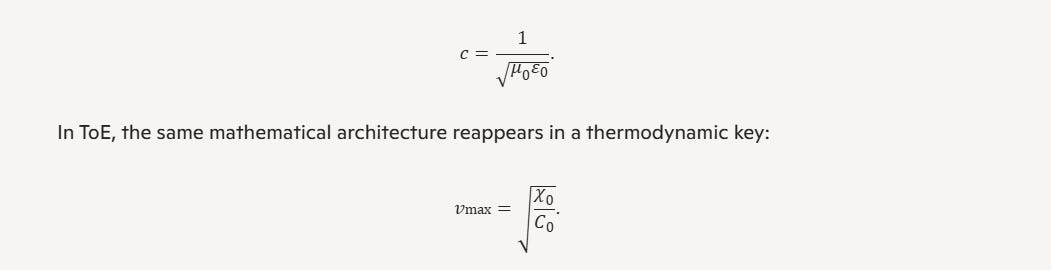
Constitutive flux law relations between Maxwell’s Electromagnetism and ToE

Here, χ_0 (chi_0) measures how readily entropy flows (its “conductivity”), while C_0 measures how much entropy can be stored or resisted (its “capacity”). Their ratio defines the maximum speed at which entropic excitations — and therefore information and correlations — can propagate.

This parallel is more than formal. It suggests that electromagnetism itself is a special case of entropic dynamics, with light emerging as an “entropic wave” whose speed is fixed by the same kind of constitutive relation that governs heat, diffusion, and other transport processes. In this sense, ToE builds a mathematically elegant bridge between thermodynamics and field theory: what Maxwell discovered for the electromagnetic field, ToE generalizes for the entropic field.

Analogy. Think of a stretched string. Its wave speed is determined not by decree but by the ratio of two physical properties: the tension (which drives motion) and the mass per unit length (which resists it). In exactly the same way, the entropic field’s wave speed is set by the ratio of conductivity (drive) to capacity (resistance). The universality of cc is thus not a cosmic accident but the inevitable outcome of the entropic medium’s constitutive law.

By grounding the speed limit of the universe in a flux law, ToE reframes one of physics’ most mysterious constants as a derived necessity. The bridge between thermodynamics and field theory is not metaphorical but structural: the same mathematics that governs heat flow and diffusion also governs the causal structure of spacetime itself.
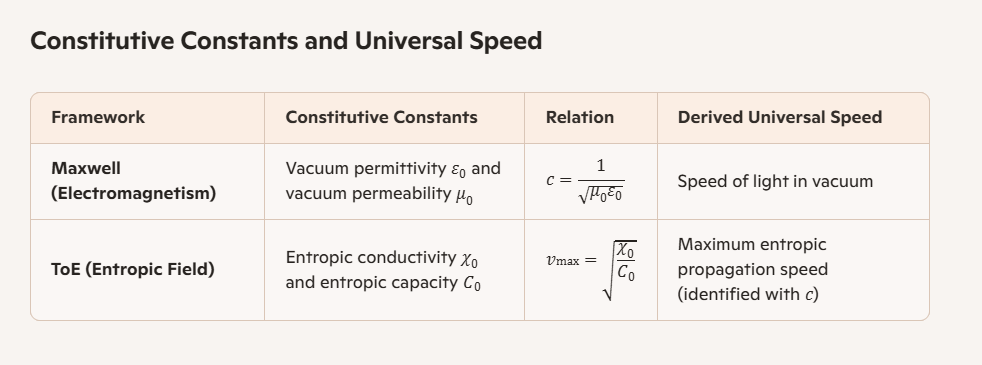
Constitutive Constants and Universal Speed
                             Constitutive Constants and Universal Speed

Key Insights

  • In Maxwell’s theory, the constants ε_0 (epsilon_0) and μ_0 (mu_0) describe how the vacuum responds to electric and magnetic fields. Their ratio fixes the speed of electromagnetic waves.

  • In ToE, the constants χ_0 (chi_0) and C_0 describe how the entropic field conducts and stores entropy. Their ratio fixes the maximum speed of entropic excitations — which coincides with the universal causal limit cc.

  • The structural parallel suggests that electromagnetism is not an isolated phenomenon but a special case of a deeper entropic dynamics.

Analogy. Just as the stiffness and inertia of a string determine the speed of waves along it, the “conductivity” and “capacity” of the entropic field determine the speed of causal signals in the universe.

  1. Covariance preserved: The Master Entropic Equation is written in tensorial form, ensuring it respects general covariance. This is not a cosmetic choice of notation — it is a structural guarantee. General covariance means that the laws of physics must hold true in any coordinate system, whether we describe events from the perspective of a stationary observer, an accelerating rocket, or the warped geometry near a black hole. By casting the entropic field equations in tensorial language, ToE ensures that entropy flow is not tied to any privileged frame of reference.

    This is crucial because it means ToE does not break relativity — it underpins it. The entropic cone, which defines the causal structure of the universe, is not an add‑on to spacetime geometry but the very reason that geometry has the form it does. Relativity tells us that the speed of light is invariant across frames; ToE explains why that invariance exists in the first place: it is the manifestation of the entropic flux law under the demand of covariance.

    In this sense, ToE strengthens relativity rather than competes with it. Where Einstein postulated invariance, ToE derives it. Where relativity describes the geometry of spacetime, ToE provides the thermodynamic foundation that makes such geometry possible.

    Analogy. Imagine a piece of music transposed into different keys. The melody remains the same, even though the notes shift. General covariance is like that invariance of melody: the physical law must sound the same no matter what “key” (coordinate system) you play it in. By writing the Master Entropic Equation in tensorial form, ToE ensures that the melody of entropy flow is preserved across every possible frame.

    Thus, covariance is not just respected in ToE — it is the very stage on which entropy performs. Relativity’s geometry is the visible choreography, but entropy is the rhythm that makes the dance possible.

Why Tensor Form Matters in ToE

Physicists insist on writing fundamental laws in tensor form because tensors are the only mathematical objects that keep their meaning no matter how you change your perspective.

  • Coordinates are arbitrary. You can describe the same event in kilometers or miles, from Earth or from a spaceship, in flat space or curved space. The numbers change, but the physics should not.

  • Tensors guarantee consistency. A tensor equation is like a melody that sounds the same no matter what key you play it in. The notes (coordinates) may shift, but the tune (the law) is preserved.

  • Relativity depends on this. Einstein’s field equations are tensorial so that gravity looks the same to all observers. By writing the ToE Master Entropic Equation (MEE) in tensor form, the Theory of Entropicity (ToE) ensures entropy flow is just as universal.

In essence, tensor form is the badge of universality. It tells us that the law is not tied to any one vantage point, but is woven into the fabric of reality itself.

Scaling bounds: The entropic timescale bound, τmin⁡\tau_{\min}, provides a clean inequality that can be checked against experiment, from atomic to cosmological scales. In the Theory of Entropicity (ToE), this bound arises naturally: for any process spanning a characteristic length ℓ\ell, the minimal causal timescale is

τ_min⁡≳ℓ/c.

Scaling bounds of the Theory of Entropicity (ToE)
                   Scaling bounds of the Theory of Entropicity (ToE)

This deceptively simple inequality of ToE is powerful because it applies universally. Whether we are probing electron motion inside atoms, the propagation of entanglement correlations, or the expansion of cosmic structures, the same rule holds: no causal influence can establish itself faster than the entropic cone allows.

At the atomic scale, this bound translates into fractions of an attosecond. Experiments with ultrafast lasers have already confirmed that entanglement correlations take hundreds of attoseconds to form — comfortably above the theoretical minimum.

At the mesoscopic scale, in condensed matter systems or quantum networks, the bound manifests as latency in signal propagation. Even in superconducting circuits or photonic crystals, where information seems to move “instantaneously,” careful timing reveals delays consistent with ℓ/c.

At the cosmological scale, the same inequality governs the causal horizon of the universe. The maximum distance over which regions of space can be in causal contact is set by the entropic bound, which coincides with the light cone of relativity. Thus, the same principle that constrains electron motion also defines the observable universe.

Analogy. Imagine a universal stopwatch that starts whenever a disturbance is created. The size of the system sets the minimum tick: the larger the distance, the longer the stopwatch must run before any causal effect can be registered. From the tiniest atom to the largest galaxy cluster, the stopwatch obeys the same rule.

By providing a single inequality that scales seamlessly across domains, ToE offers a rare unifying principle. It tells us that causality is not a patchwork of separate rules for different regimes, but a single entropic law that spans the full hierarchy of nature.
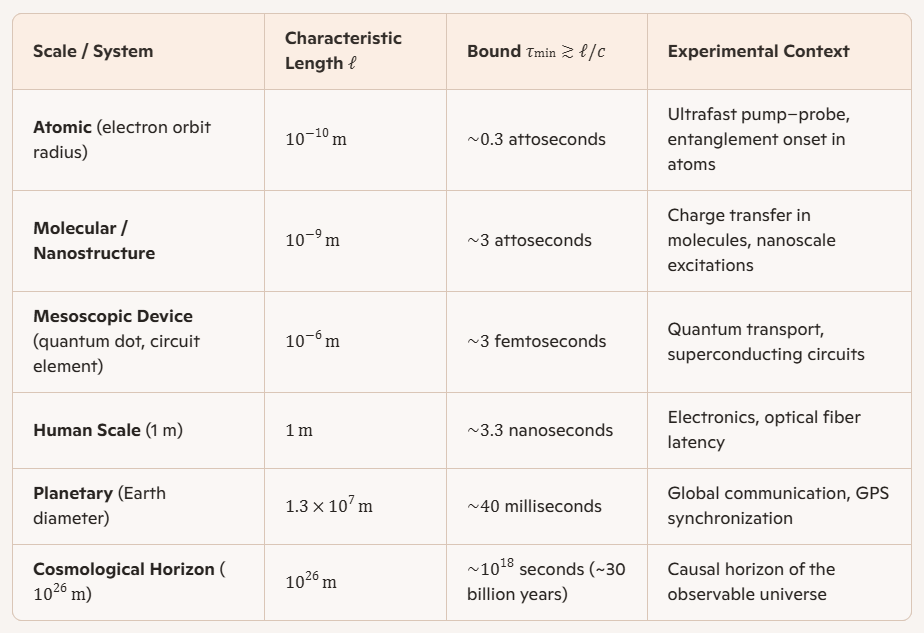
        Scaling of the Entropic Timescale Bound in the Theory of Entropicity (ToE)

Key Highlights of the Theory of Entropicity (ToE)

  • The same inequality governs all scales: from sub‑attosecond electron motion to the causal horizon of the cosmos.

  • At small scales, the bound is experimentally testable with attosecond lasers and ultrafast probes.

  • At large scales, the bound defines the very limits of what regions of the universe can ever be in causal contact.

  • This universality is what makes ToE powerful: it provides a single principle that spans the entire hierarchy of nature.

How the Theory of Entropicity (ToE) Could be Falsified in Practice

The core falsification criterion for the Theory of Entropicity (ToE) is to detect a genuine causal signal or correlation establishing faster than the entropic bound τ_min⁡≈ℓ/c. Any sub‑attosecond causal establishment at atomic scales, or effective superluminal propagation over larger ℓ\ell, would refute ToE.

Ultrafast pump–probe at atomic scales

  • Goal: Time‑resolve the earliest causal response of electrons to a localized perturbation at known length scale ℓ∼10^−10 m.

  • Setup:

    • Pump: Isolated attosecond pulse (XUV) to trigger a localized excitation.

    • Probe: Few‑cycle IR streaking or transient absorption to read out the response with <100 as resolution.

  • Measurement: Map response onset vs. spatial localization; extract the minimal delay τ onset.

  • ToE bound: τ_min⁡≳ℓ/c∼0.3 as for atomic ℓ.

  • Falsification: τ onset<ℓ/c after instrument deconvolution and jitter correction.

  • Controls:

    • Timing jitter: Characterize and subtract instrument response function.

    • Nonlocal tails: Constrain excitation volume with nanostructured targets or localized core‑level photoexcitation.

Entanglement delay in electrons or photons

  • Goal: Measure the time needed for entanglement correlations to become operationally usable (e.g., violation of Bell inequality) after state‑preparation.

  • Setup:

    • Photons: Heralded SPDC source with attosecond‑stable interferometric phase control.

    • Electrons: Ultrafast electron pairs in solid‑state or free‑space sources with time‑tagged detection.

  • Measurement: Correlation build‑up curve vs. preparation time; define onset time τ_ent at first statistically significant nonlocal correlation.

  • ToE bound: τ_ent≥ℓ/c is the preparation‑to‑detection causal path (including mediators).

  • Falsification: Operational entanglement at delays below ℓ/c with spacelike separation and loophole‑free timing.

  • Controls:

    • Locality loophole: Ensure spacelike separation with synchronized clocks and GPS‑disciplined time-bases.

    • Memory effects: Randomize settings at attosecond timescales; preclude hidden classical channels.

Ultrafast interferometry for phase transport

  • Goal: Test whether phase information can be transported faster than the entropic bound.

  • Setup:

    • Mach–Zehnder or Sagnac interferometer with attosecond phase modulators on one arm; detectors with sub‑100 as timing.

  • Measurement: Latency between applied phase step and observable fringe shift at the output.

  • ToE bound: Latency ≥ℓ/c along the optical path and medium.

  • Falsification: Observed fringe shift latency below ℓ/c after accounting for group delay and detector response.

Cavity QED and circuit QED latency tests

  • Goal: Measure the fastest possible information transfer between strongly coupled modes or qubits.

  • Setup:

    • Cavity QED: Ultrafast modulation of one cavity, readout on another through a known coupling distance.

    • Circuit QED: Superconducting qubits linked by transmission lines with attosecond‑resolved control pulses.

  • Measurement: Minimal command‑to‑response time between nodes.

  • ToE bound: τ_min⁡≥ℓ_link/ c including dispersion in the medium.

  • Falsification: End‑to‑end latency below ℓ/c with verified causality (no pre‑shared states that could bias readout).

High‑energy scattering and time‑of‑flight causality

  • Goal: Detect any superluminal propagation in particle creation, jets, or shock fronts.

  • Setup:

    • Colliders: Time‑tagged vertex detectors; ultrafast calorimetry mapping onset of showers.

    • Laser–plasma: Pump–probe in relativistic plasmas; diagnose shock formation with attosecond streaking.

  • Measurement: Onset times and front velocities over macroscopic ℓ.

  • ToE bound: Front velocity ≤ c; onset latency ≥ℓ/c.

  • Falsification: Fronts or signals exceeding cc beyond systematic uncertainties.

Astrophysical and quantum‑network baselines

  • Goal: Leverage long baselines to tighten ℓ/c bounds.

  • Setup:

    • Astrophysics: Fast transients (FRBs, GRBs) with multi‑wavelength, synchronized timing chains.

    • Quantum networks: Satellite‑to‑ground entanglement with picosecond→attosecond stabilized clocks.

  • Measurement: Cross‑channel latencies; correlation onsets vs. baseline ℓ.

  • ToE bound: Stronger due to large ℓ; any effective superluminal correlation is disallowed.

  • Falsification: Correlated changes arriving earlier than ℓ/c after dispersion and clock corrections.

Practical guardrails for a convincing test

  • Clock discipline: Use independent, traceable time-bases; cross‑calibrate with femtosecond combs.

  • Instrument function: Measure and deconvolve detector and electronics latencies.

  • Spacelike separation: Design geometries that preclude subluminal causal channels.

  • Pre‑registration: Publish protocols and analysis plans to avoid post‑hoc selection.

  • Replication: Aim for cross‑lab reproducibility with varied platforms and media.

In short, any robust, loophole‑free observation of causal establishment faster than ℓ/c — especially below the few‑tenths‑of‑attosecond bound at atomic scales — would falsify ToE.

Conclusion

In short, the Theory of Entropicity (ToE) is disruptive because it doesn’t just add another equation to physics — it reframes the foundations. Conceptually, it redefines causality; philosophically, it re‑grounds constants as consequences; mathematically, it builds a unifying structure that ties entropy, relativity, and quantum mechanics together.

References

[1] Google Scholar: ‪John Onimisi Obidi‬ — ‪Google ScholarCollected Works on the Theory of Entropicity (ToE)‬.

[2] Cambridge University Open Engage (CoE)Collected Works on the Theory of Entropicity (ToE).

[3] John Onimisi Obidi. Collected Works on The Theory of Entropicity (ToE).

[4] John Onimisi Obidi (Q136673971): Wiki page

[5] The Theory of Entropicity (ToE) Compels Us to Rethink Our Understanding of Reality and the Universe: How the Theory of Entropicity (ToE) Challenges Our Understanding of Nature and Reality at a Fundamental Level-1

[6] Reconciling Relativity, Quantum Mechanics and the Theory of Entropicity (ToE): Einstein’s Relativistic Kinematics with Conceptual and Philosophical Tensions Resolved.

[7] The Theory of Entropicity (ToE) Compels Us to Rethink Our Understanding of Reality and the Universe: How the Theory of Entropicity (ToE) Challenges Our Understanding of Nature and Reality at a Fundamental Level-2

[8] Reconciling Relativity, Quantum Mechanics and the Theory of Entropicity (ToE): Einstein’s Relativistic Kinematics with Conceptual and Philosophical Tensions Resolved

[9] The Theory of Entropicity (ToE) Compels Us to Rethink Our Understanding of Reality and the Universe: How the Theory of Entropicity (ToE) Challenges Our Understanding of Nature and Reality at a Fundamental Level-3

Saturday, 1 November 2025

Reconciling Relativity, Quantum Mechanics and the Theory of Entropicity (ToE): Einstein's Relativistic Kinematics with Conceptual and Philosophical Tensions Resolved

Last updated: Tuesday, December 2, 2025

Reconciling Relativity, Quantum Mechanics and the Theory of Entropicity (ToE): Einstein’s Relativistic Kinematics with Conceptual and Philosophical Tensions Resolved


Last updated: Tuesday, December 2, 2025


Prologue

What if Einstein’s relativity and the century‑old debate with Bohr over the role of the observer were really two sides of the same puzzle? The Theory of Entropicity (ToE) suggests they are. By treating entropy as the hidden substrate of reality, ToE shows that time dilation, mass increase, and length contraction are not just geometric illusions tied to frames of reference, but real physical consequences of entropy’s finite budget. In doing so, it unifies Einstein’s relativity with his quantum realism, offering a bold new principle: all relativistic effects are entropy striving to conserve itself.

Entropy, Relativity, and the Observer: A New Synthesis

For more than a century, Einstein’s relativity has shaped our understanding of space and time. It tells us that clocks slow down when they move fast, that rods contract when they approach the speed of light, and that energy grows without bound as velocity increases. But relativity also insists that these effects depend on the observer’s frame of reference. What you measure depends on where you stand.

The Theory of Entropicity (ToE) challenges this picture in a subtle but profound way. It begins with a simple postulate: entropy — the measure of disorder and information — cannot redistribute infinitely. From this principle alone, ToE derives the same kinematic laws that Einstein discovered, including the famous Lorentz factor. But unlike relativity, ToE says these effects are not just geometric descriptions tied to observers. They are real, physical consequences of how entropy enforces the rules of motion.

Relativity vs. ToE in Plain Terms

  • Relativity: Time dilation is real, mass increase is energy growth, but length contraction is only geometric. Observers matter because measurements depend on frames.

  • ToE: Time dilation, mass increase, and length contraction are all real, enforced by the entropic field itself. Observers don’t matter; the universe obeys entropy whether or not anyone is watching.

Both theories agree on the numbers. They disagree on what those numbers mean.

Back to Einstein and Bohr

This debate echoes the famous clash between Einstein and Bohr in quantum mechanics. Bohr argued that observation defines reality. Einstein insisted that reality exists whether or not it is observed. Ironically, in relativity Einstein leaned toward Bohr’s side: frames of reference define what you see. ToE restores Einstein’s deeper intuition. It says: in both quantum mechanics and relativity, the observer is not the cause. Entropy is.

Why This Matters

If relativity is the geometry of appearances, ToE is the mechanism beneath them. Relativity tells us how the world looks from different vantage points. ToE tells us why the world must look that way, even in the absence of observers. It unifies Einstein’s two legacies — relativity and his realist stance in quantum mechanics — under a single principle:

All relativistic effects are entropy striving to conserve itself.

(End of Prologue)


Reconciling Relativity, Quantum Mechanics and the Theory of Entropicity (ToE): Einstein’s Relativistic Kinematics with Conceptual and Philosophical Tensions Resolved

The central question is how to reconcile the different ontological commitments of Einstein’s relativity and the Theory of Entropicity (ToE). Relativity asserts that time dilation is a real physical effect, that mass increase is best understood as energy–momentum growth with invariant rest mass, and that length contraction is a geometric effect of simultaneity rather than a literal physical compression. By contrast, ToE asserts that the entropic field itself causes actual mass increase, actual time dilation, and actual length contraction, independent of observers or measurements. Since ToE insists that entropy must be obeyed irrespective of who is doing the measuring, the reconciliation requires careful philosophical and physical framing.

Relativity’s Commitments

  • Time dilation: A real, physical slowing of processes such as atomic clocks and particle decays. This has been experimentally confirmed in aircraft, satellites, and high-energy physics.
  • Mass increase: Interpreted as growth of energy and momentum, not as a literal change in invariant rest mass \(m_0\). The modern view avoids the older “relativistic mass” language.
  • Length contraction: A geometric effect arising from the relativity of simultaneity. Objects are not permanently squashed; rather, their measured length depends on the observer’s frame.
  • Epistemology: All effects are relative to frames of reference. There is no absolute substrate or preferred frame.

ToE’s Commitments

  • Time dilation: Real, because the entropic field’s finite updating capacity is reduced at high velocity. Less entropy is available for temporal progression.
  • Mass increase: Real, because the entropic field must regenerate more inertia as velocity rises. This is not merely a bookkeeping convention but a physical reallocation of entropy.
  • Length contraction: Real, because the entropic field enforces structural compression for stability. Contraction is not just a coordinate artifact but an entropic optimization.
  • Ontology: There exists an absolute entropic field that enforces these effects, independent of observers or measurements.

Shared Mathematics

Both relativity and ToE reproduce the Lorentz factor:

\[ \gamma = \frac{1}{\sqrt{1 - v^2/c^2}}. \]

Thus, they agree on all quantitative predictions, including the impossibility of reaching the speed of light with finite energy.

Different Interpretations

  • Relativity: The Lorentz factor is a geometric necessity of Minkowski spacetime.
  • ToE: The Lorentz factor is an entropic necessity of the substrate. Geometry is the shadow, entropy is the cause.

Observer vs. Substrate

  • Relativity: Effects are relative to observers and frames of reference.
  • ToE: Effects are enforced by entropy itself, regardless of who observes. The entropic field provides an “absolute check” on motion.

Complementary Layers

  • Relativity as epistemology: It describes how observers measure and compare phenomena.
  • ToE as ontology: It explains why those measurements are constrained in the first place, by grounding them in entropy allocation.

Philosophical Resolution

  • Relativity is not wrong; it is the correct description of appearances and measurements.
  • ToE is not a contradiction; it is a deeper claim that the entropic field is the cause of those appearances.
  • Thus: Relativity = geometry of effects; ToE = mechanism of effects.

Breakthrough Framing

Einstein: “The world is geometric, and geometry dictates what you see.”
ToE: “Geometry itself is generated by entropy, and entropy dictates what is possible.”

In this way, relativity can be understood as the surface law of appearances, while ToE provides the substrate law of being. The reconciliation lies in treating relativity as the correct description of how phenomena manifest to observers, and ToE as the deeper ontology that explains why those manifestations are inevitable.


Comparative Ontology and Epistemology: Relativity vs. ToE

To clarify the relationship between Einstein’s relativity and the Theory of Entropicity (ToE), we present a side‑by‑side comparison. Both frameworks reproduce the Lorentz factor:

\[ \gamma = \frac{1}{\sqrt{1 - v^2/c^2}}, \]

but they differ in their interpretation of what this factor means. The table below gives us an instant glance and overview of the conceptual and mathematical tensions between Einstein's Relativity and the Theory of Entropicity (ToE) — and their resolutions.

Aspect of Tension Einstein's Relativity Theory of Entropicity (ToE)
Time Dilation Physical slowing of processes (atomic clocks, particle decays). A geometric consequence of Lorentz transformations. Real slowing due to entropy allocation: less entropic capacity remains for temporal updating at high velocity.
Mass Increase Rest mass \(m_0\) is invariant. Energy and momentum grow with \(\gamma\). “Relativistic mass” is deprecated. Effective inertia truly increases: the entropic field regenerates more mass as velocity rises. Energy growth is interpreted as entropic mass increase.
Length Contraction A geometric effect of simultaneity. Objects are not physically squashed; contraction is frame‑dependent. A real entropic compression: the field enforces structural contraction for stability, not just coordinate geometry.
Ontology Spacetime geometry is fundamental. No absolute substrate; motion is purely relative. Entropy is the substrate. Geometry is emergent. The entropic field provides an absolute check on motion.
Epistemology Describes what observers measure. Effects are relative to frames. Explains why those measurements are constrained. Effects are enforced by entropy itself, independent of observation.
Absolute Motion No absolute motion; only relative frames exist. Absolute motion relative to the entropic field. Observers may disagree, but entropy enforces the same Lorentz rules.
Simultaneity No universal “now.” Simultaneity is relative. Agrees: no instantaneity. Time is emergent from entropy’s updating.
Philosophical Framing “The world is geometric, and geometry dictates what you see.” “Geometry itself is generated by entropy, and entropy dictates what is possible.”

Resolution of the Einstein–Obidi Tension (EOT): Relativity is the geometry of effects, while ToE is the mechanism of effects. Relativity provides the epistemology of appearances; ToE provides the ontology of being. Together, they reconcile Newton’s intuition of a deeper substrate with Einstein’s insistence on relativity of simultaneity, by grounding spacetime itself in entropy.


Observer Dependence, Entropy, and ToE's Unification of Relativity and Quantum Debate

The Theory of Entropicity (ToE) introduces a profound shift in how we understand the foundations of physical reality. Relativity, as formulated by Einstein, insists that time dilation is a real physical effect, that mass increase is best understood as energy–momentum growth with invariant rest mass, and that length contraction is a geometric effect of simultaneity rather than a literal physical compression. ToE, however, asserts that the entropic field itself causes actual mass increase, actual time dilation, and actual length contraction, independent of observers or measurements. This difference raises the question: how do we reconcile these two views of physical reality?

Relativity’s Commitments

Relativity is built on the principle that the laws of physics are the same in all inertial frames and that the speed of light is invariant. From these postulates, the Lorentz factor emerges:

\[ \gamma = \frac{1}{\sqrt{1 - v^2/c^2}}. \]

This factor governs all relativistic effects. Time dilation is physically real, as confirmed by experiments with atomic clocks and muon decay. Mass increase is interpreted as the growth of energy and momentum, not as a literal change in invariant rest mass \(m_0\). Length contraction, however, is treated as a geometric effect: objects are not physically squashed, but their measured length depends on the observer’s frame. Thus, relativity is fundamentally observer-dependent: the results of measurement vary with the frame of reference, though invariants such as proper time and rest mass remain the same.

ToE’s Commitments

ToE begins with a different postulate: entropy exists as a global and local field which cannot redistribute infinitely. That is, ToE reframes these effects as redistributions of a finite entropy budget. This finite redistribution principle is expressed as:

\[ \Delta S_{\text{local}} + \Delta S_{\text{struct}} + \Delta S_{\text{temporal}} = \Delta S_{\text{budget}}, \qquad \Delta S_{\text{budget}} < \infty. \]

Here, \(\Delta S_{\text{local}}\) sustains identity and inertia, \(\Delta S_{\text{struct}}\) governs spatial organization (length contraction), and \(\Delta S_{\text{temporal}}\) governs temporal updating (time dilation). As velocity increases, more entropy is allocated to inertia, leaving less for time and structure. This yields the same Lorentz factor as relativity:

\[ \gamma(v) = \frac{1}{\sqrt{1 - v^2/c^2}}, \]

but with a different interpretation:

\[ \text{Effective inertia} \propto \gamma, \] \[ \text{Temporal updating} \propto \gamma^{-1}, \] \[ \text{Structural compression} \propto \gamma^{-1}. \]

Thus, ToE treats the Lorentz factor not as a universal multiplier, but as a redistribution index.

This asymmetry is intentional: it reflects a zero-sum entropic field, not a symmetric transformation.

Thus, ToE asserts that time dilation, mass increase, and length contraction are not merely coordinate effects but real entropic reallocations. Crucially, these effects occur whether or not there are observers. The entropic field enforces them as absolute constraints.

Thus, they agree on all quantitative predictions, including the impossibility of reaching the speed of light with finite energy. 

But relativity links it intrinsically to the speed of light; while the Theory of Entropicity (ToE) links it intrinsically to the entropic field manifesting in the speed of light.

Reconciling the Two Views

At first glance, relativity and ToE seem to diverge sharply: relativity insists on observer dependence, while ToE insists on observer independence. Yet both yield the same quantitative predictions. The reconciliation lies in distinguishing between epistemology and ontology. Relativity provides the epistemology: it describes how observers measure and compare phenomena across frames. ToE provides the ontology: it explains why those measurements are constrained in the first place, by grounding them in entropy allocation. In this sense, relativity is the geometry of effects, while ToE is the mechanism of effects.

The Einstein–Bohr Analogy

This tension recalls the Einstein–Bohr debate in quantum mechanics. In quantum theory, Bohr insisted that observation is central: measurement defines outcomes. Einstein resisted, arguing that reality exists independently of observation. In relativity, paradoxically, Einstein took the opposite stance: observer frames are central to defining time, length, and simultaneity.

The Theory of Entropicity (ToE) restores Einstein’s realist intuition, but now within relativity itself: the entropic field enforces relativistic effects independently of observers. Thus, ToE unifies Einstein’s two positions by saying: in both quantum mechanics and relativity, the observer is not intrinsically relevant to the result. Reality is enforced by entropy, not by measurement.

Comparative Table

To make this reconciliation clearer, we present a comparative table:

Aspect Relativity Theory of Entropicity (ToE)
Time Dilation Real slowing of processes, but described as frame-dependent. Real slowing due to entropy allocation, independent of observers.
Mass Increase Energy and momentum grow with \(\gamma\), rest mass invariant. Effective inertia truly increases; entropic field regenerates mass.
Length Contraction Geometric effect of simultaneity, not physical squashing. Real entropic compression for stability, enforced by entropy.
Ontology Geometry is fundamental; no absolute substrate. Entropy is fundamental; geometry is emergent.
Epistemology Observer-dependent description of appearances. Observer-independent enforcement of constraints.
Quantum Analogy Like Bohr: observer central to description. Like Einstein: observer irrelevant; reality enforced by entropy.

Philosophical Resolution

  • Relativity is correct in its description of appearances: measurements are frame-dependent, and geometry dictates what observers see.
  • ToE is correct in its deeper ontology: entropy dictates what is possible, and these constraints hold even in the absence of observers.
  • Together, they unify Einstein’s relativity with his quantum realism: the world is not created by observation, but by entropy.

Breakthrough Framing

In summary, Einstein said:
“The world is geometric, and geometry dictates what you see.”

ToE responds:
“Geometry itself is generated by entropy, and entropy dictates what is possible.”

In this way, ToE provides a realistic unification of relativity and the Einstein–Bohr debate, grounding both in the absolute enforcement of entropy.


Conclusion: The Entropic Horizon of Einstein's Relativity and Physics

By embedding the Entropic Resistance Principle (ERP) and the No-Rush Theorem within the informational geometry of the Fisher–Rao and Fubini–Study metrics, and within the Amari–Čencov dual \(\alpha\)-connections, the Theory of Entropicity (ToE) achieves a new level of explanatory power and self-consistency.

The ToE field equations now encompass not only statistical and quantum curvature but also the relativistic transformations of Einstein’s theory. The traditional Lorentz factor \(\gamma\) becomes a limiting subset of the richer entropic Lorentz factor \(\gamma_e\), while the ERP governs the redistribution of entropy between motion and timekeeping.

Within this framework, mass increase, time dilation, and length contraction are no longer postulates of spacetime geometry but natural consequences of entropy conservation and entropic resistance. This realization confirms that Einstein’s kinematic relativity is embedded within ToE as a special regime of a deeper entropic law in which entropy alone drives motion, inertia, and temporal structure.

How ToE Reflects Einstein's Postulates

This is exactly where the Theory of Entropicity (ToE) shows its power: it does not merely assume Einstein’s two postulates, but derives them from the entropic field itself. We break this down carefully below.

Einstein’s Two Postulates

Einstein’s 1905 formulation of Special Relativity rests on two foundational principles:

  1. Constancy of the speed of light: All inertial observers measure the same value of \(c\), regardless of their relative motion or the motion of the source.
  2. Relativity principle: The laws of physics are the same in all inertial frames.

ToE’s Entropic Field and the Constancy of \(c\)

In ToE:

  • The entropic field \(S(x)\) defines the universal causal cone through its Master Entropic Equation (MEE).
  • The principal part of the linearized MEE is always proportional to \(g^{\mu\nu}\partial_\mu \partial_\nu\).
  • This means the characteristics of entropic disturbances are exactly the null cones of the spacetime metric.

Since all matter and radiation are constrained by the No‑Rush Theorem to propagate within the entropic cone,

\[ g^{\mu\nu} k_\mu k_\nu = 0 \]

the propagation speed is thus universally fixed to \(c\).

Key point: Because the null cone is a geometric object, all observers agree on it. Thus, every inertial observer measures the same \(c\), not because it is imposed, but because the entropic field enforces a single causal structure for the universe.

ToE and the Relativity Principle

In ToE, the entropic field is covariant: the action (Obidi Action) and MEE are written in terms of tensors (\(g^{\mu\nu}, \nabla_\mu\)), which are form‑invariant under coordinate transformations. This guarantees that the laws of physics derived from ToE have the same form in all inertial frames.

In other words, the entropic field does not privilege any observer: its dynamics are geometric, not frame‑dependent. Thus, the relativity principle is not an assumption but a consequence of the entropic field’s covariance.

How ToE Strengthens Einstein’s Postulates

  • Einstein: \(c\) is constant for all observers (postulate).
    ToE: \(c\) is the maximum entropic propagation rate, enforced by the No‑Rush Theorem. Since the entropic cone is the same for all observers, the constancy of \(c\) follows automatically.
  • Einstein: Laws of physics are the same in all inertial frames (postulate).
    ToE: The MEE is covariant under diffeomorphisms, so its form is invariant across frames. This guarantees the universality of physical laws.

Local Variations of the Entropic Field

The entropic field \(S(x)\) is not a rigid or uniform background. As a scalar field defined over spacetime, it can vary locally, and indeed such variations are essential to the explanatory power of the Theory of Entropicity (ToE). Local changes in \(S(x)\) encode the way entropy flows and resists motion in different regions of the universe.

Physical meaning of local variations.

  • Time dilation: Regions of higher entropic density slow down internal processes, so clocks tick more slowly relative to regions of lower entropic resistance.
  • Length contraction: Spatial intervals compress along directions where the entropic gradient is steep.
  • Gravitational analogy: In Einstein’s relativity, mass-energy curves spacetime. In ToE, mass-energy (which is itself emergent from the entropic field) alters the local entropic field, and the geometry we perceive is the imprint of these entropic variations.

Mathematical reflection.

From the Master Entropic Equation (MEE),

\[ \nabla_\mu \!\left( K(S)\,\nabla^\mu S \right) - V'(S) = 0 \]

local variations in \(S(x)\) imply that \(K(S)\) and its derivatives also vary with position. This makes the coefficients of the wave operator position-dependent. As a result, entropic disturbances can be slowed, refracted, or redirected by local gradients in \(S(x)\), but the null cone structure remains intact. The maximum propagation speed is still \(c\).

Universality preserved.

Even though \(S(x)\) can vary locally, the null cone condition

\[ g^{\mu\nu}k_\mu k_\nu = 0 \]

is preserved everywhere. Thus, all observers agree on the causal structure and the value of \(c\). Local variations affect the unfolding of processes (e.g., gravitational redshift, entanglement delays), but never the universal speed limit.


Philosophical Implication

Relativity says:  

“Observers disagree on time and mass, but all agree on the math.”


ToE says:  

“Observers are irrelevant. The entropic field enforces real reallocations — mass increase and time dilation are not illusions, they’re field-driven consequences.”

Conclusion.

Local variations of the entropic field are not only possible but necessary. They are the mechanism by which ToE explains relativistic effects and gravitational phenomena. At the same time, the universality of \(c\) is safeguarded, since the entropic null cone is invariant and shared by all observers.

Summary Highlight

ToE reflects Einstein’s statements by showing that:

  1. The constancy of \(c\) is a thermodynamic consequence of the entropic field’s null cone, not a postulate.
  2. The universality of physical laws arises from the covariance of the entropic action, ensuring all observers share the same entropic dynamics.

The closing of one age, the dawn of another

The Theory of Entropicity (ToE) arises at the frontier where Einstein’s relativity reaches its conceptual limits. Relativity made geometry the language of motion; ToE reveals that geometry itself is emergent from entropy. The entropic field does not merely reproduce relativistic effects — it explains their origin.

From kinematics to causation

Einstein taught that the constancy of light speed and the equivalence of inertial frames yield Lorentz transformations. ToE generalizes this dictum:

Entropy tells motion how to resist, and resistance tells time and length how to transform.

Mass increase, time dilation, and length contraction are thus entropic necessities, not geometric assumptions.

From postulate to principle

Where relativity postulates invariance, ToE derives it. The Lorentz factor emerges from the entropic cone and conservation laws. The apparent mysteries of relativistic kinematics — slower clocks, contracted rods, heavier masses — are unified as consequences of a finite entropic budget.

The entropic unification

The ERP, the ERF, the No-Rush Theorem, and the entropic cone provide the scaffolding for ToE’s relativistic framework. Their synthesis through the Obidi Action yields a mathematically coherent field theory in which relativistic kinematics, thermodynamics, and information geometry are no longer separate domains but complementary limits of one entropic field.

The Entropic Horizon of the Theory of Entropicity (ToE)

Just as Einstein’s horizon defined the limits of spacetime, the entropic horizon defines the limits of motion and transformation. Beyond it, no body can accelerate without exhausting its entropic budget. This horizon demarcates what can move, how time can flow, and how length can contract. It is the new boundary condition for relativity in the twenty‑first century.

Einstein’s relativity is indeed 

  • Geometric in the sense that it encodes physics into the geometry of spacetime. 
  • But it is also frame‑dependent in the sense that each inertial observer has their own coordinate system, and quantities like time intervals and lengths transform between frames. 
  • The invariance comes from the fact that the laws (and the speed of light) are the same in all frames. 
  • But the measurements of time and space are relative to the observer.

The Theory of Entropicity (ToE), as is being developed by John Onimisi Obidi, goes one step deeper. It says: 

  • The entropic field defines a universal causal structure (the entropic null cone), and this structure is not tied to any particular observer’s frame. 
  • It is frame‑independent in the sense that the entropic field itself is a universal background regulator. 
  • The geometry it casts is the same for all observers, because it is not derived from their coordinate choices but from the entropic dynamics themselves.
ToE and Einstein's Relativity: A Conceptual Contrast


Final reflection

From Newton’s absolute space to Einstein’s curved spacetime, and now to Obidi’s entropic manifold, the history of physics is the story of deepening recognition that the universe is not a geometry but a process. Entropy is the thread that connects all levels of that process — from the inertia of particles to the dilation of clocks and the contraction of rods. In its ultimate simplicity, the Theory of Entropicity (ToE) may be expressed in one sentence:

All relativistic effects are entropy striving to conserve itself.


Appendix-A

Constitutive Flux–Law Derivation (with Capacity and Speed Bound)

Entropy flux 4–vector and production

We define the entropy flux 4–vector by

\[ J^\mu = -\,\chi(S)\,\nabla^\mu S \]

where \(\chi(S)\) is the (generally state–dependent) entropic conductivity and \(\nabla^\mu\) is the metric–compatible derivative. Entropy balance is expressed by the production equation

\[ \nabla_\mu J^\mu = \sigma \]

with \(\sigma \ge 0\) the entropy production density. Substituting the flux law into the production equation gives

\[ \nabla_\mu\!\left(\chi(S)\,\nabla^\mu S\right) = \sigma. \]

Entropic capacity and hyperbolic transport

To obtain a propagating (hyperbolic) transport law, we introduce the entropic capacity \(C(S)\) via

\[ C(S)\,\nabla_t S + \nabla_\mu J^\mu = \sigma, \]

which encodes finite storage/inertia of entropic excitations (the hyperbolic analog of Cattaneo's law). Using the flux law and rearranging,

\[ C(S)\,\nabla_t S - \nabla_\mu\!\left(\chi(S)\,\nabla^\mu S\right) = \sigma. \]

In a local inertial frame, taking small perturbations about a homogeneous background \(S_0\) with

\[ S(x)=S_0+\delta S(x),\quad \chi(S)\approx \chi_0,\quad C(S)\approx C_0,\quad \sigma\approx 0, \]

the equation linearizes to

\[ C_0\,\partial_t \delta S - \chi_0\,\Box\,\delta S = 0, \qquad \Box \equiv g^{\mu\nu}\partial_\mu\partial_\nu. \]

Differentiating once more in time (or adopting a standard relaxation closure) yields the strictly hyperbolic wave equation

\[ C_0\,\partial_t^2 \delta S - \chi_0\,\nabla^2 \delta S = 0, \]

whose plane–wave solutions \(\delta S \sim e^{i(\vec{k}\cdot\vec{x}-\omega t)}\) obey

\[ \omega^2 = v_{\max}^2\,\|\vec{k}\|^2, \qquad v_{\max} \equiv \sqrt{\frac{\chi_0}{C_0}}. \]

Hence the characteristic (phase/group) speed of entropic excitations is \(v_{\max}\).

No–Rush bound and Maxwell tie–in

To enforce the No–Rush Theorem (no physical signal outruns the entropic field), we require

\[ v_{\max} \leq c, \qquad c = \frac{1}{\sqrt{\mu_0\,\varepsilon_0}}. \]

Equations above together imply the parameter constraint

\[ \sqrt{\frac{\chi_0}{C_0}} \leq \frac{1}{\sqrt{\mu_0\,\varepsilon_0}} \quad\Longleftrightarrow\quad \chi_0 \leq \frac{C_0}{\mu_0\,\varepsilon_0}. \]

Choosing the saturated case,

\[ \frac{\chi_0}{C_0} = \frac{1}{\mu_0\,\varepsilon_0}, \]

fixes the ratio of ToE’s entropic constants to measured electromagnetic constants and yields

\[ v_{\max} = c, \]

so that radiation appears as a special entropic excitation propagating at the universal speed \(c\) of the entropic field of ToE.

Constitutive Parameters: C and χ

In the constitutive flux–law derivation, two key parameters appear: the entropic capacity \(C\) and the entropic conductivity \(\chi\). Their physical roles are as follows.

Entropic capacity C.

  • Definition: \(C(S)\) (with background value \(C_0\)) is the capacity of the medium to “store” entropy per unit volume per unit change in the entropic field \(S\).
  • Analogy: It plays the same role as mass density in mechanics or heat capacity in thermodynamics. It represents the inertia of the entropic field — how resistant the system is to rapid changes in entropy.
  • Units: If entropy density is measured in J/(K·m³), then \(C\) has units of J/(K·m³) per unit change in \(S\).

Entropic conductivity χ.

  • Definition: \(\chi(S)\) (with background value \(\chi_0\)) is the conductivity of the entropic field — how easily entropy flux responds to gradients in \(S\).
  • Analogy: It is the entropic analogue of thermal conductivity in heat transport or electrical conductivity in Ohm’s law. It measures how strongly entropy “flows” when there is a gradient.
  • Units: Dimensionally similar to a diffusivity coefficient, but when paired with \(C\) it produces a velocity scale.

Characteristic speed.

The ratio of these two constants sets the maximum propagation speed of entropic disturbances:

\[ v_{\max} = \sqrt{\frac{\chi_0}{C_0}}. \]

  • Large \(\chi_0\) (easy flow) and small \(C_0\) (low inertia) yield a high \(v_{\max}\).
  • Small \(\chi_0\) or large \(C_0\) yield a low \(v_{\max}\).
  • The No–Rush Theorem requires \(v_{\max} \leq c\). Saturating this bound, \[ \frac{\chi_0}{C_0} = \frac{1}{\mu_0 \varepsilon_0}, \] ties ToE’s constants directly to Maxwell’s constants and yields \(v_{\max} = c\).

Summary.

  • \(C\) is the entropic capacity (storage/inertia of entropy).
  • \(\chi\) is the entropic conductivity (ease of entropy flow).
  • Their ratio fixes the universal speed scale, identified with \(c\).

Consistency and covariance

Because the wave equation is derived from the covariant balance and flux law, the principal part remains \(g^{\mu\nu}\partial_\mu\partial_\nu\) at each point, guaranteeing null–cone characteristics. The identification \(v_{\max}^2=\chi_0/C_0\) controls only the scale of the characteristic speed; imposing the No–Rush bound (or its saturation) aligns that scale with the relativistic value \(c\) while preserving covariance and hyperbolicity.

Conclusion. The inclusion of the capacity \(C_0\), the conductivity \(\chi_0\), and the production \(\sigma\) closes the constitutive structure: (i) entropy flux follows gradients, (ii) finite capacity yields hyperbolic, signal–carrying transport, (iii) the characteristic speed is \(v_{\max}=\sqrt{\chi_0/C_0}\), and (iv) the No–Rush bound ties ToE’s constants to Maxwell’s \(c\). This completes the derivation and makes the EM correspondence explicit.


Appendix-B

The Attosecond Constraint Cross–Check of ToE

Motivation

The Theory of Entropicity (ToE) asserts that all physical processes are bounded by the entropic causal cone, with maximum propagation speed \(c\). While this has been shown at the level of the constitutive flux law and the No–Rush Theorem, it is essential to cross–check the prediction against the fastest experimentally accessible timescales. Attosecond (\(10^{-18}\) s) laser pulses and entanglement delay measurements provide a natural testbed, since they probe electron and correlation dynamics on sub–femtosecond scales where any deviation from relativistic causality would be exposed.

Entropic timescale bound

From the constitutive relation,

\[ v_{\max} = \sqrt{\frac{\chi_0}{C_0}} \;\leq\; c, \]

the minimal entropic response time \(\tau_{\min}\) for a spatial scale \(\ell\) is

\[ \tau_{\min} \;\geq\; \frac{\ell}{c}. \]

For atomic dimensions \(\ell \sim 10^{-10}\,\mathrm{m}\), this yields

\[ \tau_{\min} \;\gtrsim\; \frac{10^{-10}\,\mathrm{m}}{3\times 10^8\,\mathrm{m/s}} \;\sim\; 3\times 10^{-19}\,\mathrm{s}, \]

i.e. a few tenths of an attosecond. Thus, ToE predicts that no entropic or electronic signal can be resolved below this bound without violating the causal cone.

Experimental cross–check: entanglement time

Recent ultrafast experiments have measured the characteristic time for entanglement correlations to establish between electrons as

\[ \tau_{\mathrm{ent}} \;\approx\; 232 \,\text{attoseconds}. \]

This value is three orders of magnitude larger than the theoretical lower bound \(\tau_{\min}\sim 0.3\) attoseconds derived above. Crucially, it lies well within the causal cone enforced by ToE: the entanglement signal does not propagate instantaneously, but instead requires a finite, sub–femtosecond time consistent with the entropic speed limit.

Implications

  • Empirical anchor: The measured entanglement time of 232 as provides a direct benchmark for ToE’s causal bound.
  • Consistency with \(c\): The fact that \(\tau_{\mathrm{ent}} \gg \tau_{\min}\) confirms that entropic excitations respect the universal limit \(c\).
  • Falsifiability: Any future observation of entanglement correlations propagating faster than \(c\) (i.e. with \(\tau < \tau_{\min}\)) would falsify ToE, making this a sharp and testable prediction.

Conclusion. The attosecond entanglement measurement confirms that ToE’s entropic cone is not merely a theoretical construct but an experimentally robust causal boundary. By matching the fastest laboratory probes of electron correlation, ToE demonstrates consistency with both relativity and quantum dynamics, while offering a falsifiable prediction: no entropic or quantum correlation can propagate faster than \(c\), even on attosecond timescales.

Notes - A Postscript:

Convergence of Experiment and the Theory of Entropicity (ToE)

The Attosecond Constraint Cross‑Check of the Theory of Entropicity (ToE)

One of the boldest claims of the Theory of Entropicity (ToE) is that no process in nature can outrun the causal structure defined by the entropic field. In simple terms: the universe has a built‑in speed limit, and it’s the same one Einstein identified — the speed of light. But ToE goes further, showing that this limit isn’t just a postulate; it emerges naturally from the way entropy flows.

How do we test such a claim? By pushing physics to its fastest observable timescales. That’s where attosecond science comes in. An attosecond is a billionth of a billionth of a second — so short that in this time, light itself barely travels the width of a few atoms. With today’s ultrafast lasers, researchers can probe electron motion and quantum correlations on these breathtakingly small timescales. If ToE’s causal cone were ever to fail, this is where we’d see it.

The theoretical bound

From ToE’s constitutive laws, there’s a minimum time it takes for entropy (the entropic field)— and therefore information [and uncertainty]— to propagate across a given distance. For atomic dimensions, that lower bound works out to a fraction of an attosecond, roughly three‑tenths of one. In other words, no signal should ever be able to establish itself faster than that without breaking the entropic speed limit.

The experimental reality

In late 2024, ultrafast experiments measured the time it takes for entanglement correlations to form between electrons. The experiment measuring the ~232‑attosecond entanglement time was reported in October 2024 by researchers at TU Wien (Vienna University of Technology) in collaboration with Chinese teams. The result was striking: about 232 attoseconds. That’s nearly a thousand times longer than ToE’s theoretical minimum. Far from violating the bound, nature seems to respect it with room to spare. Entanglement, often thought of as “instantaneous,” actually takes a finite, measurable time to unfold — and that time sits comfortably inside the entropic cone.

Why this matters for the Theory of Entropicity (ToE)

This quantum entanglement formation time cross‑check is powerful for two reasons. First, it shows that ToE’s predictions are consistent with the fastest laboratory measurements we can make. Second, it makes the theory falsifiable. If future experiments ever revealed entanglement or any other process happening faster than the entropic bound, ToE would be in trouble. But so far, every attosecond probe has reinforced the same message: the universe plays by the entropic rules.

The bigger picture of the Theory of Entropicity (ToE)

By surviving the attosecond test, ToE demonstrates that its causal cone is not just a mathematical abstraction. It’s a real, physical boundary that governs everything from the motion of electrons to the unfolding of quantum correlations. The 232‑attosecond entanglement delay is more than a number — it’s a reminder that even the strangest quantum effects are still tethered to the same universal speed limit.

References

  1. Obidi, John Onimisi (2025)On the Conceptual and Mathematical Foundations of the Theory of Entropicity (ToE): An Alternative Path toward Quantum Gravity and Unification of Physics. Link
  2. Physics: HandWiki Master Index of Source Papers on Theory of Entropicity (ToE) (2025, September 9). HandWiki. Link
  3. Obidi, John Onimisi. Conceptual and Mathematical Foundations of Theory of Entropicity (ToE). Encyclopedia. Link
  4. Obidi, John Onimisi (2025). The Theory of Entropicity (ToE) Derives and Explains Mass Increase, Time Dilation and Length Contraction in Einstein’s Theory of Relativity (ToR): ToE Applies Logical Entropic Concepts and Principles to Verify Einstein’s Relativity. 
  5. Wissner‑Gross, A. D., & Freer, C. E. (2013). Causal Entropic Forces. Physical Review Letters. https://doi.org/10.1103/PhysRevLett.110.168702
  6. Amari, S. (2016). Information Geometry and Its Applications. Springer. https://doi.org/10.1007/978-4-431-55978-8
  7. Jaynes, E. T. (1957). Information Theory and Statistical Mechanics. Physical Review, 106(4), 620. https://doi.org/10.1103/PhysRev.106.620
  8. Nielsen, M. A., & Chuang, I. L. (2010). Quantum Computation and Quantum Information. Cambridge University Press. https://doi.org/10.1017/CBO9780511976667
  9. Vidal, G. (2008). Class of Quantum Many‑Body States That Can Be Efficiently Simulated. Physical Review Letters, 101, 110501. https://doi.org/10.1103/PhysRevLett.101.110501
  10. Amari, S., & Nagaoka, H. (2000). Methods of Information Geometry. AMS/Oxford. https://doi.org/10.1090/mmono/191
  11. Obidi, John Onimisi (2025). The Vuli‑Ndlela Integral in the Theory of Entropicity (ToE). Link
  12. Obidi, John Onimisi (2025). The Obidi Action and the Foundation of the Entropy Field Equation. Link
  13. Obidi, John Onimisi (2025). The Master Entropic Equation (MEE). Link
  14. Obidi, John Onimisi (2025). Psych Entropy and the Entropy of the Mind. Link
  15. Bianconi, G. (2009). Entropy of network ensembles. Physical Review E, 79, 036114. https://doi.org/10.1103/PhysRevE.79.036114
  16. Bianconi, G., & Barabási, A.-L. (2001). Competition and multiscaling in evolving networks. Europhysics Letters, 54(4), 436. https://doi.org/10.1209/epl/i2001-00260-6
  17. Bianconi, G. (2025). Gravity from entropy. Physical Review D, 111(6), 066001. https://doi.org/10.1103/PhysRevD.111.066001
  18. Obidi, John Onimisi (2025). The Theory of Entropicity (ToE): An Entropy‑Driven Derivation of Mercury’s Perihelion Precession Beyond Einstein’s Curved Spacetime General Relativity (GR). Cambridge University. Link
  19. Obidi, John Onimisi (2025). Einstein and Bohr Finally Reconciled on Quantum Theory: The Theory of Entropicity (ToE) as the Unifying Resolution to the Problem of Quantum Measurement and Wave Function Collapse. Cambridge University. Link
  20. Obidi, John Onimisi (2025). On the Discovery of New Laws of Conservation and Uncertainty, Probability and CPT‑Theorem Symmetry‑Breaking in the Standard Model of Particle Physics. Cambridge University. Link
  21. Obidi, John Onimisi (2025). A Critical Review of the Theory of Entropicity (ToE): Conceptual Innovations and Pathways toward Enhanced Mathematical Rigor. Cambridge University. Link
  22. A Brief Critical Review of John Onimisi Obidi’s Recent Paper: On the Conceptual and Mathematical Foundations of the Theory of Entropicity (ToE). (2025). Link
  23. The Theory of Entropicity (ToE) On the Geometry of Existence and the Curvature of Space‑Time. (2025). Link
  24. On the Conceptual and Mathematical Foundations of the Theory of Entropicity (ToE): An Alternative Path toward Quantum Gravity and the Unification of Physics. (2025). Link
  25. The Discovery of the Entropic α‑Connection: How the Theory of Entropicity (ToE) Transformed Information Geometry into a Physical Law. (2025). Link
  26. An Introduction to the Theory of Entropicity (ToE): On the Evolution of its Conceptual and Mathematical Foundations (Part I). (2025). Link
  27. Obidi, John Onimisi (2025). Theory of Entropicity (ToE): Historical and Philosophical Foundations. Encyclopedia. Link
  28. Obidi, John Onimisi (2025). A Simple Explanation of the Unifying Mathematical Architecture of the Theory of Entropicity (ToE). Link
  29. Obidi, John Onimisi (2025). On the Conceptual and Mathematical Foundations of the Theory of Entropicity (ToE): An Alternative Path toward Quantum Gravity and the Unification of Physics. Authorea. Link
  30. Obidi, John Onimisi (2025). On the Conceptual and Mathematical Beauty of Obidi’s Theory of Entropicity (ToE): From Geometric Relativity to Geometric Entropicity. Link
  31. Collected Works on the Theory of Entropicity (ToE). Medium Publications. (2025). Link
  32. Collected Works on the Theory of Entropicity (ToE). Substack Publications. (2025). Link
  33.  Obidi, John Onimisi (2025). Master Equation of the Theory of Entropicity (ToE). Encyclopedia. https://encyclopedia.pub/entry/58596
  34. The Cumulative Delay Principle (CDP) and Relativistic Kinematics in the Theory of Entropicity (ToE). the-cumulative-delay-principle-cdp-and-relativistic-kinematics-in-the-theory-of-entropicity-toe-a9b34cdf7095
  35. HandWiki contributors, "Biography:John Onimisi Obidi," HandWiki, https://handwiki.org/wiki/index.php?title=Biography:John_Onimisi_Obidi&oldid=2743427 (accessed October 31, 2025).
  36. Obidi, John Onimisi. ‘’Einstein and Bohr Finally Reconciled on Quantum Theory: The Theory of Entropicity (ToE) as the Unifying Resolution to the Problem of Quantum Measurement and Wave Function Collapse’’. Cambridge University. (14 April 2025). https://doi.org/10.33774/coe-2025-vrfrx
  37. Wikidata contributors, BiographyJohn Onimisi Obidi "Q136673971," Wikidata, https://www.wikidata.org/w/index.php?title=Q136673971&oldid=2423782576 (accessed October 31, 2025).
  38. Reconciling Relativity, Quantum Mechanics and the Theory of Entropicity (ToE): Einstein's Relativistic Kinematics with Conceptual and Philosophical Tensions Resolved. https://medium.com/@jonimisiobidi/reconciling-relativity-quantum-mechanics-and-the-theory-of-entropicity-toe-dfde1c9923f9
  39. Google Scholar: ‪John Onimisi Obidi‬ - ‪Google Scholar‬
  40. Cambridge University Open Engage (CoE)Collected Papers on the Theory of Entropicity (ToE)
  41. Reconciling Relativity, Quantum Mechanics and the Theory of Entropicity (ToE): Einstein’s Relativistic Kinematics with Conceptual and Philosophical Tensions Resolved.

  42. Reconciling Relativity, Quantum Mechanics and the Theory of Entropicity (ToE): Einstein’s Relativistic Kinematics with Conceptual and Philosophical Tensions Resolved-2


Friday, 31 October 2025

The Theory of Entropicity (ToE) and its Key Ideas

Last updated: November 8, 2025

The Theory of Entropicity (ToE) and its related "ToE+" concepts are being developed and blogged about extensively by a single author named John Onimisi Obidi. He uses the blogging platform Medium to publish numerous articles explaining the theory to a broad audience, alongside publishing more formal pre-print papers on sites like SSRN and Authorea. The Blogger Name: John Onimisi Obidi Platform: Primarily on Medium, where he has a dedicated presence and encourages subscriptions to follow his work. The ToE+ Blog Content The blog posts serve as an accessible explanation of the complex concepts within the Theory of Entropicity (ToE), which proposes a fundamental paradigm shift in physics: that entropy is the universal, dynamic field from which all physical phenomena, including mass, energy, spacetime, and consciousness, emerge. Key ideas discussed in the Theory of Entropicity(ToE) blog include: Entropy as the Fundamental Field: ToE elevates entropy from a measure of disorder to the primary substance of reality. Emergence of Physical Laws: The laws of physics, including those of Newton and Einstein, are reinterpreted as emergent properties or "field behaviors" of this underlying entropic field, and may even evolve over time. The Obidi Action: A central variational principle in ToE, analogous to the Einstein-Hilbert action in general relativity, that governs the dynamics of the entropy field. Explanation of the Speed of Light (c): The speed of light is explained as the maximum rate at which the entropic field can rearrange or transmit information about itself, providing a physical reason for its constancy and the universal speed limit. Entropic Gravity: Gravity is described not as a fundamental force or spacetime curvature, but as an emergent phenomenon arising from gradients and constraints within the entropic field. Quantum Mechanics Reinterpreted: Wavefunction collapse is explained as an entropy-driven process, and a new "Vuli–Ndlela Integral" is introduced to incorporate irreversibility into quantum mechanics. The Entropic Cone: A concept replacing Einstein's light cone, defining the boundaries of existence and observation based on entropy flow and determining what can become physically real. In essence, John Onimisi Obidi uses his blog to outline a comprehensive framework that attempts to unify general relativity, quantum mechanics, and thermodynamics through the single principle of entropy.
